Knives, Axes & Tool Maintenance
The Anatomy of a Cutting Tool
In the wilderness, an edged tool is an extension of the human hand. It provides the mechanical advantage necessary to process wood, prepare food, and construct shelter. Understanding the metallurgy, edge geometry, and proper maintenance of these tools dictates their performance and longevity.
The core debate in bushcraft blades lies between high-carbon steel and stainless steel. High-carbon steels are generally easier to sharpen in the field, hold an edge well under heavy impact, and can throw sparks when struck against flint. However, they are highly susceptible to rust and require constant oiling. Stainless steels resist corrosion exceptionally well but are often harder to sharpen and more prone to micro-chipping during high-impact tasks like batoning wood.
Edge Grinds
The profile of the blade edge determines its optimal use case. The three most common grinds encountered in bushcraft are:
- Scandi Grind: A single, wide bevel that runs to the edge without a secondary micro-bevel. It bites aggressively into wood, making it ideal for carving and feather sticks. It is also exceptionally easy to sharpen, as the wide bevel acts as a built-in angle guide on the stone.
- Convex Grind: The edge curves outward like the profile of an apple seed. This provides massive amount of steel behind the edge, making it incredibly durable for chopping and splitting. It is the standard grind for axes and large survival knives.
- Flat Grind: Tapers consistently from the spine to a secondary edge bevel. It excels at slicing and food preparation but lacks the wedging power of a Scandi grind for deep wood processing.
Axe Safety and "The Blood Circle"
The axe is an indispensable tool for heavy wood processing, but it demands profound respect. A deflected axe swing will naturally track toward the user's lower legs. Establishing safety protocols is non-negotiable.
The "Blood Circle" (or safety circle) is the spherical radius dictated by your fully extended arm holding the tool. Before un-sheathing an axe or knife, visually and physically clear this radius of people, obstructions, and overhanging branches that could deflect a swing. When processing wood with an axe, always strike over a solid chopping block. Never strike wood lying flat on the soft ground, as the axe will bite through and bury into the earth, dulling the edge instantly on rocks and sand.
Field Sharpening
A blade degrades microscopically with every cut. The edge rolls over or chips. Maintenance should be proactive, not reactive. Do not wait until the blade is dull to sharpen it.
Whetstones
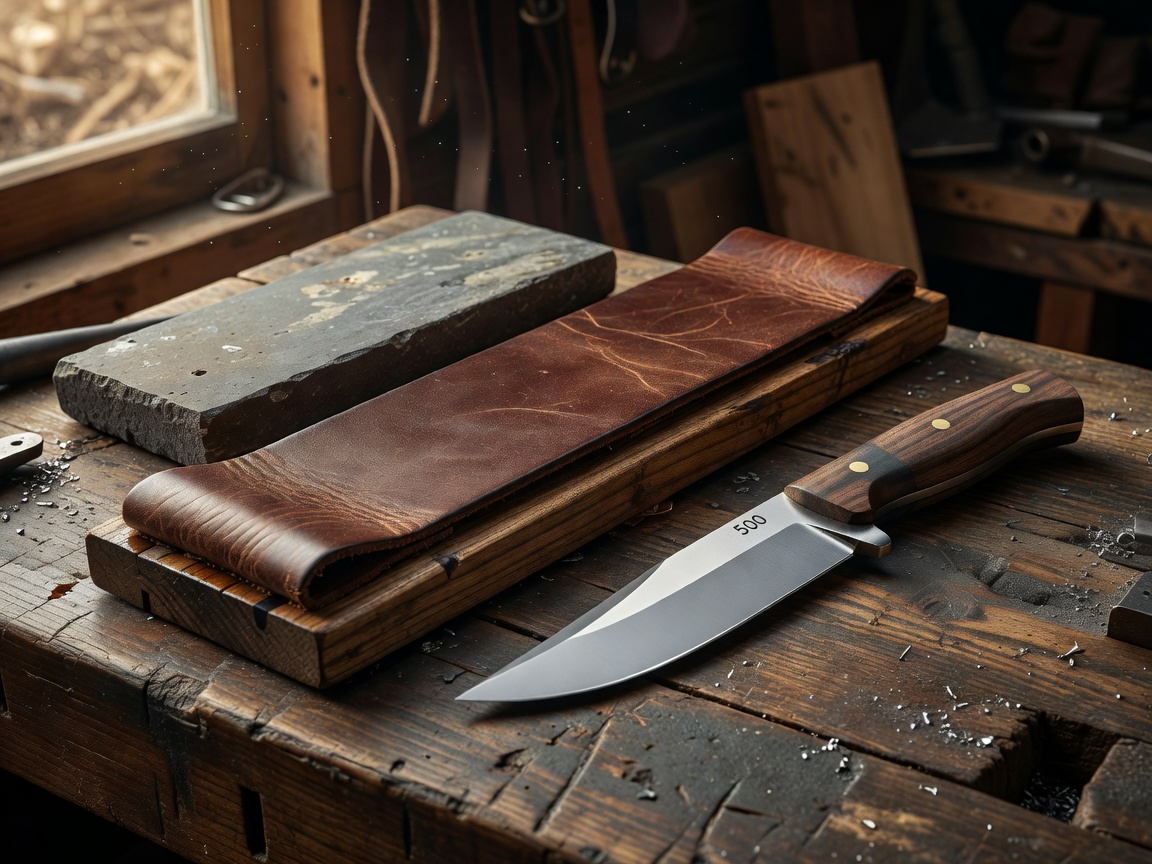
Field stones, typically double-sided with a coarse and fine grit, are standard issue. The sharpening process involves pushing the edge across the stone as if trying to slice a thin layer off the stone's surface. Maintaining a consistent angle is the most critical and challenging aspect. For a Scandi grind, lay the bevel flat against the stone and lock your wrists.
| Grit Range | Purpose | Application |
|---|---|---|
| 200 - 400 (Coarse) | Edge Repair | Removing chips or establishing a new bevel. |
| 800 - 1000 (Medium) | Sharpening | Bringing a dull edge back to working sharpness. |
| 3000+ (Fine) | Honing | Polishing the edge to a razor finish. |
Stropping
Stropping aligns the microscopic burr created during sharpening. Using a leather belt loaded with a mild abrasive compound, draw the blade backward (trailing edge) away from the cutting direction. A few passes on a strop after daily use will keep an edge remarkably sharp, delaying the need to remove steel on a whetstone.
Conclusion
Your tools are your lifeline. Keep carbon steel dry and lightly oiled with food-safe oils if you use the knife for food prep. Check axe handles for micro-fractures, ensure sheaths are secure, and treat every cut with deliberate focus and respect for the blade.