Bushcraft Shelter Building: Thermal Mass & Mechanics
The Foundation of Field Survival
Exposure is the most immediate threat in a wilderness survival scenario. While modern synthetic sleeping bags and waterproof bivouacs are highly effective, possessing the knowledge to construct a resilient natural shelter is paramount. The core principles of bushcraft shelter building center around location selection, thermal mass, moisture management, and structural integrity.
A poorly sited shelter will fail regardless of its construction quality. Before cutting a single bough or moving any debris, one must evaluate the terrain. Avoid natural hollows where cold air pools at night, and stay clear of dry riverbeds subject to flash flooding. Furthermore, looking up is non-negotiable; identify and avoid "widowmakers"—dead branches hung up in the canopy that could fall in high winds.
Types of Natural Shelters
The Debris Hut
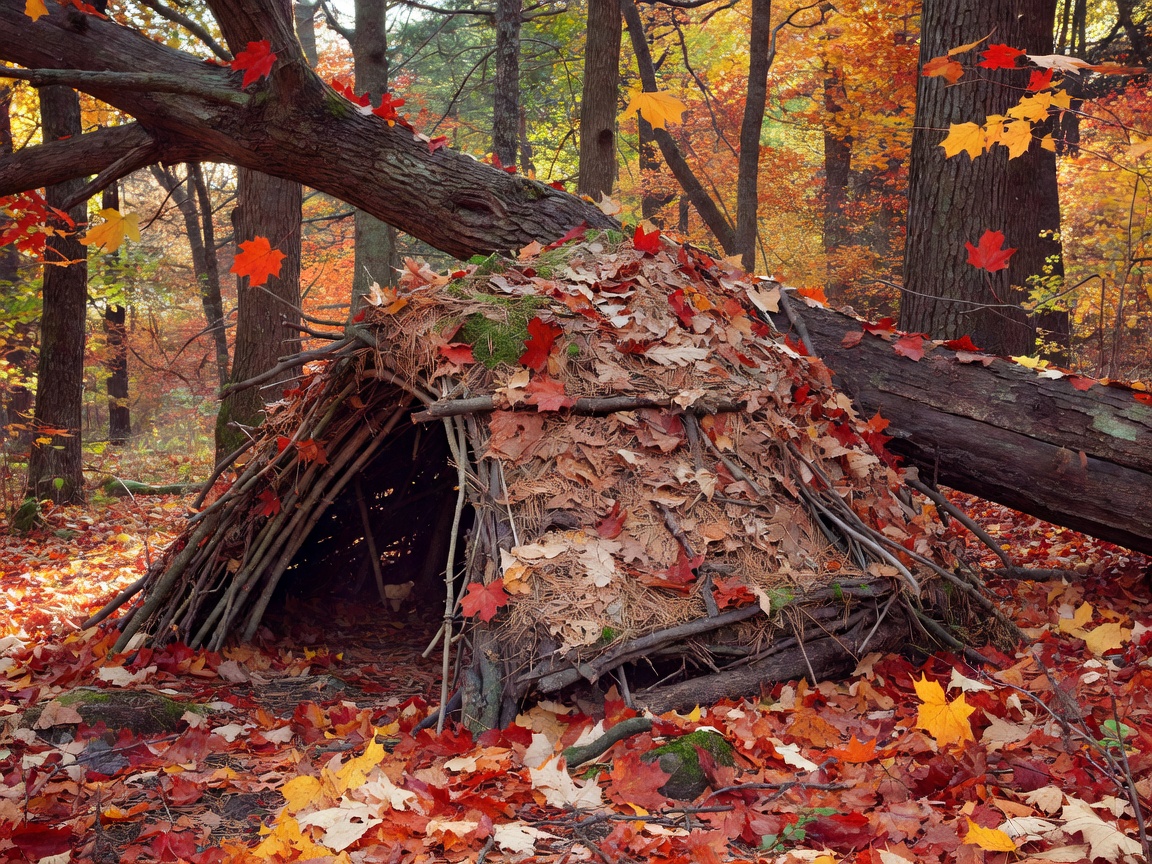
The debris hut is arguably the most efficient natural shelter for trapping body heat without the need for an external fire. It operates on the same principle as a sleeping bag: dead air space. By surrounding yourself with a massive volume of dry, dead organic material, you create a layer of trapped air that your body heat can warm.
Construction begins with a sturdy ridgepole—a strong branch slightly longer than your height. One end rests on a solid support (a low tree branch, a stump, or a lashed bipod), while the other rests on the ground. The interior space should be just large enough to accommodate your body. If the space is too cavernous, your body will expend excessive calories attempting to heat the empty void.
Rib branches are laid against the ridgepole, creating an A-frame structure. This framework is then covered with a lattice of smaller twigs to prevent the final layer from falling through. The critical phase is the insulation: pile leaves, dry moss, ferns, and pine needles over the structure. To be effective in near-freezing temperatures, the debris layer must be a minimum of three feet thick. Finally, place heavier branches over the debris to prevent the wind from stripping your insulation away.
The Lean-To
Unlike the debris hut, a lean-to relies almost entirely on an external heat source. It is fundamentally a windbreak and a heat reflector. Constructing a lean-to involves securing a horizontal crossbeam between two trees or driven stakes, and angling poles down from the beam to the ground on the windward side.
This angled wall is then thatched with boughs, starting from the bottom and working upwards so that water sheds over the layer below it, much like roof shingles. A long fire is built parallel to the open face of the lean-to. The angled roof catches the radiant heat from the fire and reflects it down onto the occupant.
Insulation and Ground Beds
A critical mistake novices make is ignoring the ground. Conduction—the transfer of heat through direct contact—will aggressively drain your core temperature if you lie directly on the earth. The ground is an infinite heat sink.
Constructing a raised bed or a thick mattress of dry materials is essential. Pine boughs, dry grasses, or compacted leaves can serve this purpose. The compressed thickness of your ground pad should be at least six inches. If building over snow, a platform of thick logs should be laid down before the insulation layer to prevent your body heat from melting the snow beneath you.
Cordage and Lashing
While natural cordage can be woven from the inner bark of trees like willow or cedar, or from robust roots such as spruce, understanding structural mechanics can often eliminate the need for lashings entirely. Gravity and friction are powerful allies. Using natural crotches in trees or interlocking branches can create joints that tighten under weight rather than slipping.
Pros and Cons Comparison
| Shelter Type | Primary Benefit | Major Drawback | Energy Required |
|---|---|---|---|
| Debris Hut | Excellent heat retention without a fire. | Claustrophobic; requires massive amounts of dry material. | Very High |
| Lean-To | Fast to build; allows fire heating. | Poor insulation; wind direction changes can cause freezing. | Medium |
| Snow Cave | Windproof; steady thermal environment. | Risk of collapse; requires deep, consolidated snow. | High |
Conclusion
Shelter building is a caloric investment. It is crucial to balance the energy expended in gathering materials and constructing the shelter against the thermal protection gained. Always start building at least two hours before sunset, work methodically, and prioritize insulation from the ground up.