Fire Craft: From Sparks to Sustained Flames
The Physics of Fire
Fire requires three elements: heat, fuel, and oxygen. Remove any one of these from the fire triangle, and combustion ceases. In bushcraft, the challenge is rarely finding fuel, but rather sourcing dry fuel and generating the initial heat under adverse conditions. Successful fire craft is 90% preparation and 10% ignition.
Before striking a single spark, one must gather materials in three distinct categories: tinder, kindling, and main fuel. Attempting to light thick branches directly from a match or a spark is a common novice error that invariably leads to failure and frustration.
Ignition Methods
Ferrocerium Rods
The modern ferrocerium (ferro) rod is an essential piece of survival kit. It operates effectively in freezing rain, sleet, and snow. By aggressively scraping a hard, sharp edge (such as the 90-degree spine of a bushcraft knife) down the rod, you strip off fragments of the metal alloy which ignite in the air at temperatures exceeding 3,000°C.
The technique requires directing these molten globules into a highly combustible tinder bundle. Rather than moving the knife down the rod, which risks knocking the tinder apart, pull the rod back while keeping the knife stationary. This ensures precision targeting of the sparks.
Flint and Steel
Traditional flint and steel relies on striking a piece of high-carbon steel against a hard, sharp-edged rock (like flint, chert, or quartz). The rock shears off microscopic curls of steel, which oxidize rapidly and heat to a glow. These sparks are much cooler and less energetic than ferrocerium sparks, requiring specialized tinder to catch them—most commonly char cloth or specific funguses like true tinder fungus.
Friction Fire: The Bow Drill
Mastering the bow drill is a rite of passage. It utilizes mechanical friction to generate an ember. The components include a spindle, a hearth board, a bearing block (handhold), and a bow. The wood choice for the spindle and hearth board is critical; medium-soft woods like cedar, willow, or cottonwood are ideal. They must be bone dry.
The bow rotates the spindle under downward pressure, grinding wood dust into a notch cut in the hearth board. As friction increases, the dust darkens and begins to smoke. With sustained, smooth bowing, the dust pile reaches ignition temperature and coalesces into a glowing ember. This fragile ember is then transferred to a pre-prepared tinder bundle and blown into flame.
Tinder and Fire Lays
Processing Tinder
Tinder must have massive surface area. Birch bark is widely considered the king of natural tinders due to its high concentration of volatile oils, allowing it to ignite even when wet. Other excellent options include the scraped inner bark of cedar or tulip poplar, dried grasses, and fatwood (pine wood heavily saturated with resin).
The Teepee and Log Cabin
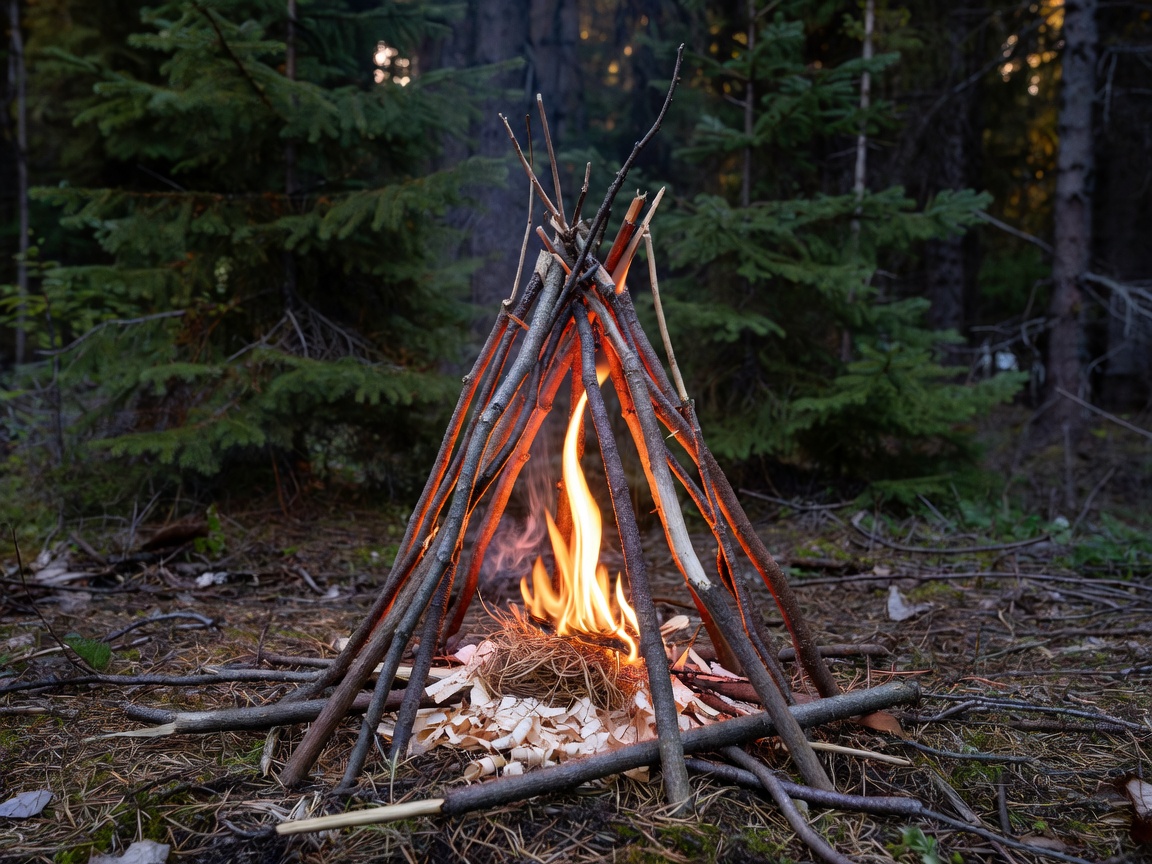
Once you have a flame, structuring the kindling determines whether the fire survives. The **Teepee lay** involves leaning thin kindling against each other in a cone shape over the tinder. It draws oxygen effectively from below and concentrates heat at the apex, forcing the flame upward rapidly.
The **Log Cabin lay** consists of placing sticks in a square, overlapping at the corners. It is more stable than the teepee, allows for excellent airflow, and eventually collapses in on itself to form a dense, uniform bed of coals, which is essential for cooking.
| Ignition Source | Reliability in Wet | Skill Required | Temperature of Spark/Ember |
|---|---|---|---|
| Ferrocerium Rod | Very High | Low | ~3,000°C |
| Flint & Steel | Low | Medium | ~400°C |
| Bow Drill | Very Low | Very High | ~400°C (Ember) |
Sustaining and Extinguishing
A sustained fire requires feeding. As the fire grows, progressively increase the diameter of the wood. Splitting thick logs exposes the dry inner heartwood, which is vital if it has been raining. Always establish a perimeter using rocks or cleared earth to prevent root fires or surface spread.
When breaking camp, extinguishing the fire thoroughly is mandatory. Drown the coals with water, stir the ashes with a stick, and drown them again until the area is completely cool to the touch. Leaving a smoldering fire is irresponsible and dangerous.